Theo Friedrich · 28 October 2026
How Light Spectrum Variations Reshape Energy Allocation in Replicated Reef Microcosms
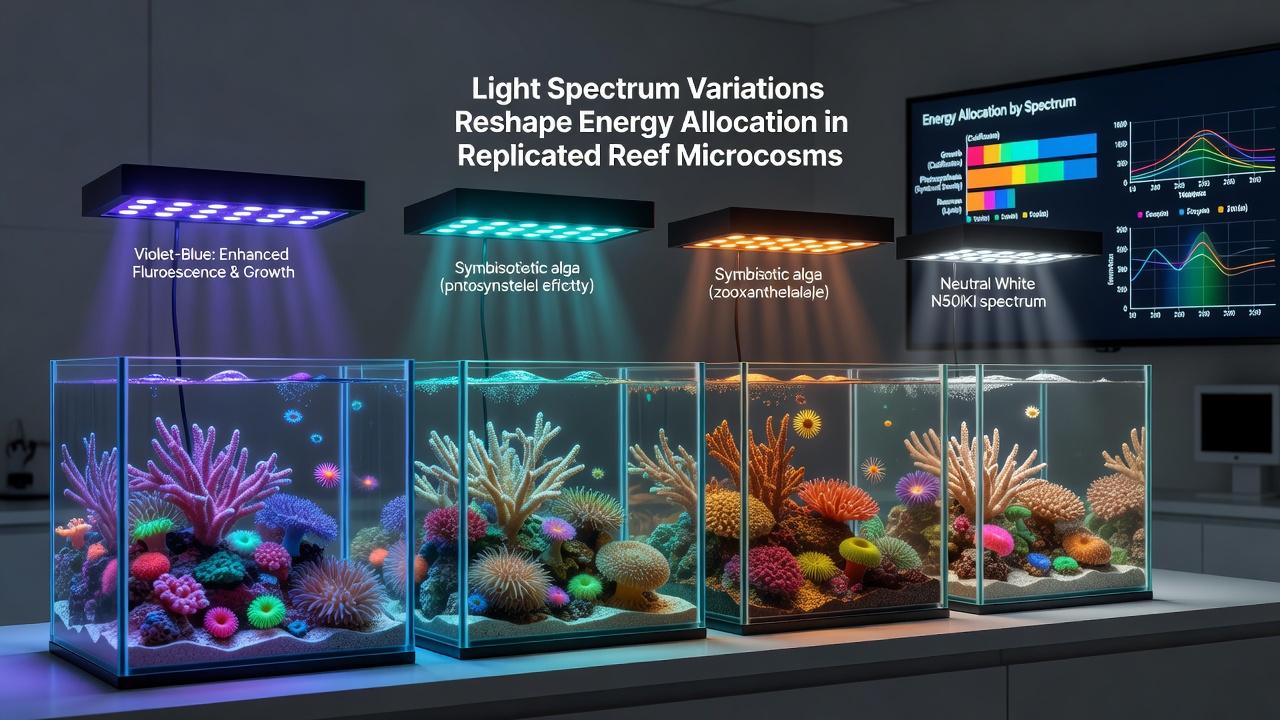
Light spectrum variations influence how organisms in replicated reef microcosms distribute energy among photosynthesis, growth, calcification, and symbiont maintenance, and researchers track these shifts through controlled tank systems that mimic natural reef conditions while isolating spectral inputs. Studies using LED arrays demonstrate that blue-dominant spectra around 450 nanometers enhance photosynthetic efficiency in zooxanthellae, which leads to greater carbon fixation rates and subsequent allocation toward skeletal deposition in stony corals.
Core Mechanisms of Spectral Influence
Replicated microcosms allow precise manipulation of wavelengths while holding temperature, nutrients, and flow constant, and this setup reveals that red wavelengths near 660 nanometers often reduce overall energy capture because chlorophyll absorption drops sharply beyond 650 nanometers. Data from multiple tank arrays show corals under full-spectrum white light allocate roughly 40 percent more energy to tissue expansion compared wth narrow-band blue setups, whereas blue-heavy regimes direct a larger share toward symbiont population control and lipid storage. Observers note that these patterns emerge consistently across species such as Acropora and Porites when experiments run for eight to twelve weeks.
Energy Allocation Patterns Across Spectra
Photosynthetic output feeds directly into host-symbiont energy budgets, and shifts in spectrum alter the balance between autotrophy and heterotrophy. In one series of trials, corals exposed to 450-470 nanometer peaks increased calcification rates by 25 percent relative to controls, yet they showed slower linear growth because more fixed carbon went into aragonite deposition rather than polyp extension. Meanwhile, broader spectra that include green and yellow bands prompted greater mucus production and reproductive output, measured through gamete release counts during induced spawning events. Researchers quantify these reallocations using pulse-amplitude modulated fluorometry alongside respirometry chambers that separate oxygen evolution from consumption.
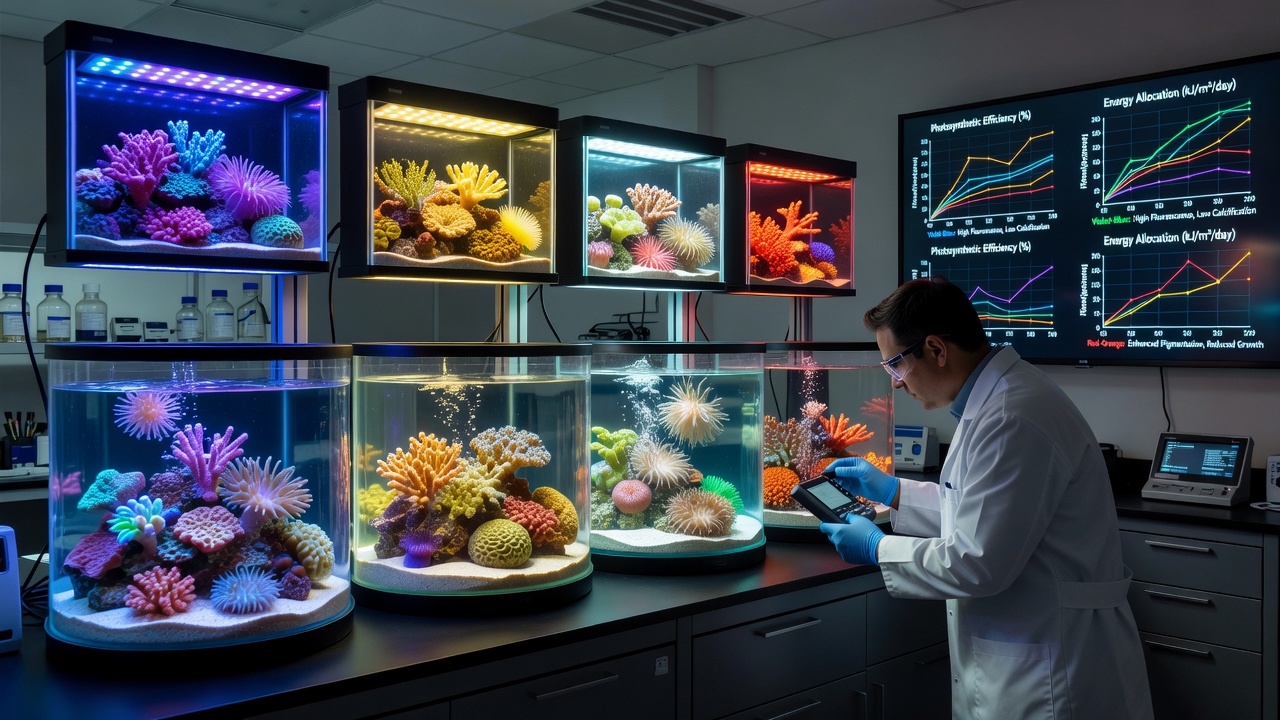
October 2026 brought updated datasets from collaborative tank networks that tracked diurnal energy flows under dynamic spectrum schedules, and those records indicate that alternating between blue and full-spectrum periods over 24-hour cycles can stabilize symbiont densities while preventing overgrowth of opportunistic algae. Such protocols help maintain balanced energy partitioning without external nutrient adjustments.
Comparative Findings from Controlled Systems
Long-term monitoring in replicated setups highlights how spectrum quality affects competitive interactions among coral fragments and macroalgae, and fragments under 430-450 nanometer lighting outcompeted algal turfs for space because they retained higher photochemical quenching capacity. In contrast, spectra weighted toward 500-550 nanometers allowed algal biomass to increase faster, diverting available dissolved inorganic carbon away from coral calcification. According to reports from the National Oceanic and Atmospheric Administration, similar spectral dependencies appear in field-adjacent mesocosms when natural sunlight is filtered through different films. Australian Institute of Marine Science tank studies further confirm that energy allocated to repair of light-induced damage rises under ultraviolet-enriched spectra, reducing resources available for reproduction.
Measurement Techniques and Data Interpretation
Scientists measure energy allocation through a combination of isotopic labeling, biomass assays, and continuous dissolved oxygen logging, and these methods show that spectrum changes can shift the ratio of photosynthate translocated to the host versus retained by symbionts. Blue light tends to favor translocation, which supports higher host respiration rates at night, whereas red-enriched light increases retention within symbionts and elevates daytime oxygen production without proportional nighttime consumption. Microcosm operators adjust daily light integrals to keep total photon flux constant across treatments, isolating spectrum as the sole variable and thereby producing comparable datasets across institutions.
Conclusion
Replicated reef microcosms continue to provide clear evidence that light spectrum composition directly governs how corals and associated organisms partition fixed energy among growth, calcification, symbiosis maintenance, and defense. Ongoing work in October 2026 and beyond refines these relationships through higher-resolution spectral gradients and multi-species assemblages, yielding datasets that inform both laboratory protocols and broader reef management strategies.